Why I Built Asaanbil: The Letter Was Never the Hard Part
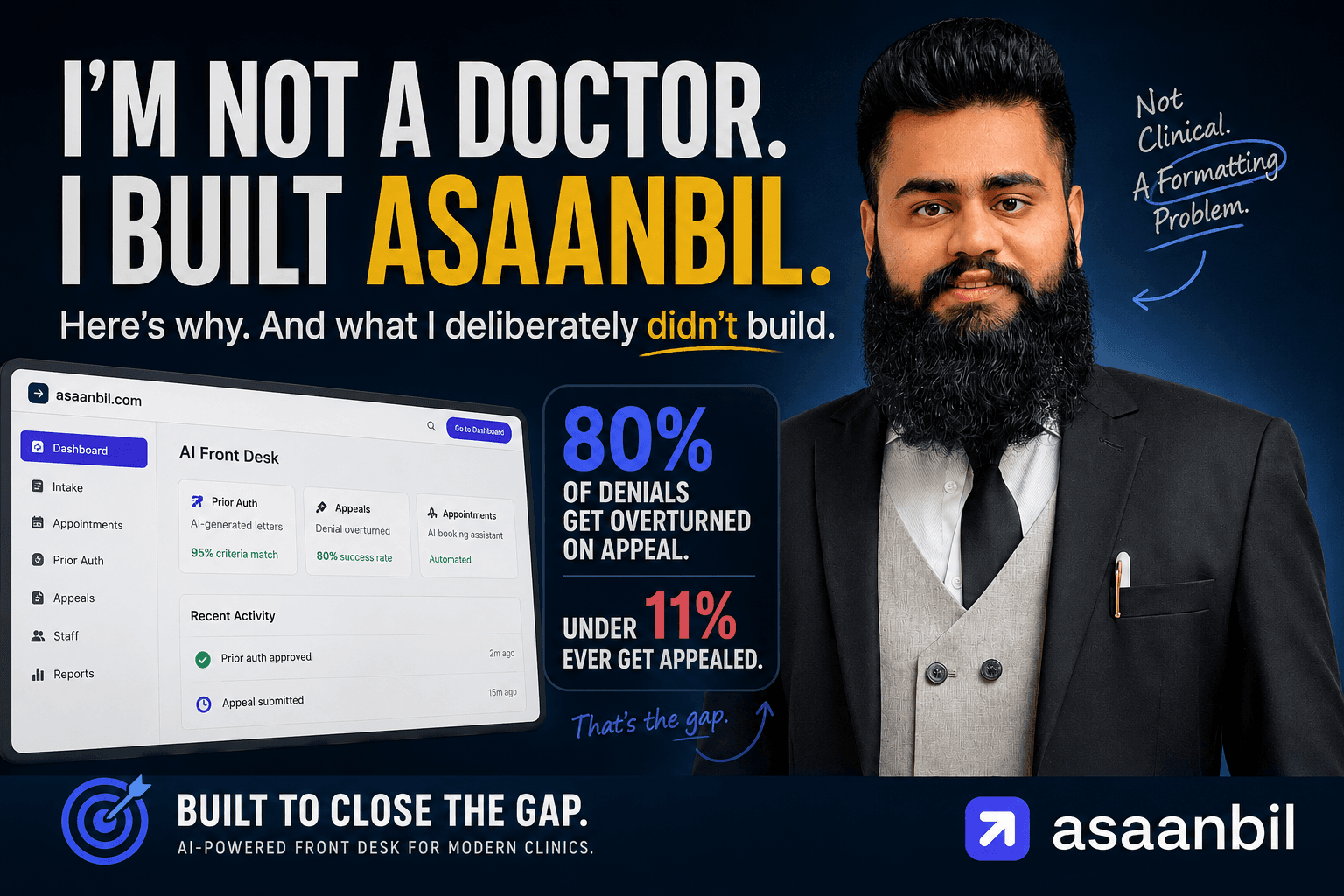
I'm not a doctor. I've never sat across from a payer's peer-to-peer reviewer, never had a patient's care delayed because of a letter I was responsible for writing.
What I did was notice the same pattern over and over, across specialties that otherwise had nothing in common — and once I saw it clearly, I couldn't unsee it.
The pattern underneath every complaint
Talk to enough practice managers about prior authorization and the surface details change every time. An orthopedic practice waiting on a spinal fusion approval. A rheumatologist's office re-fighting a biologic denial for the third time. A radiology front desk trying to guess which specific clause Aetna wants this month.
Underneath all of it, the same thing was happening. The physician or their staff knew exactly why a procedure was medically necessary. The clinical judgment was never actually in question. What ate the time was translating that judgment into the specific structure, language, and citation a payer reviewer expects — the right heading, the right clause, the right level of clinical detail.
That's not clinical work. It's a formatting and translation problem wearing a clinical costume.
Once I understood that distinction, the whole shape of the problem changed for me. This wasn't a "doctors need to document better" issue. It was a "the paperwork step is disconnected from the clinical judgment it's supposed to represent" issue — and that kind of problem is fixable by someone who isn't a clinician, as long as they're honest about what they don't know.
The stat that made it concrete
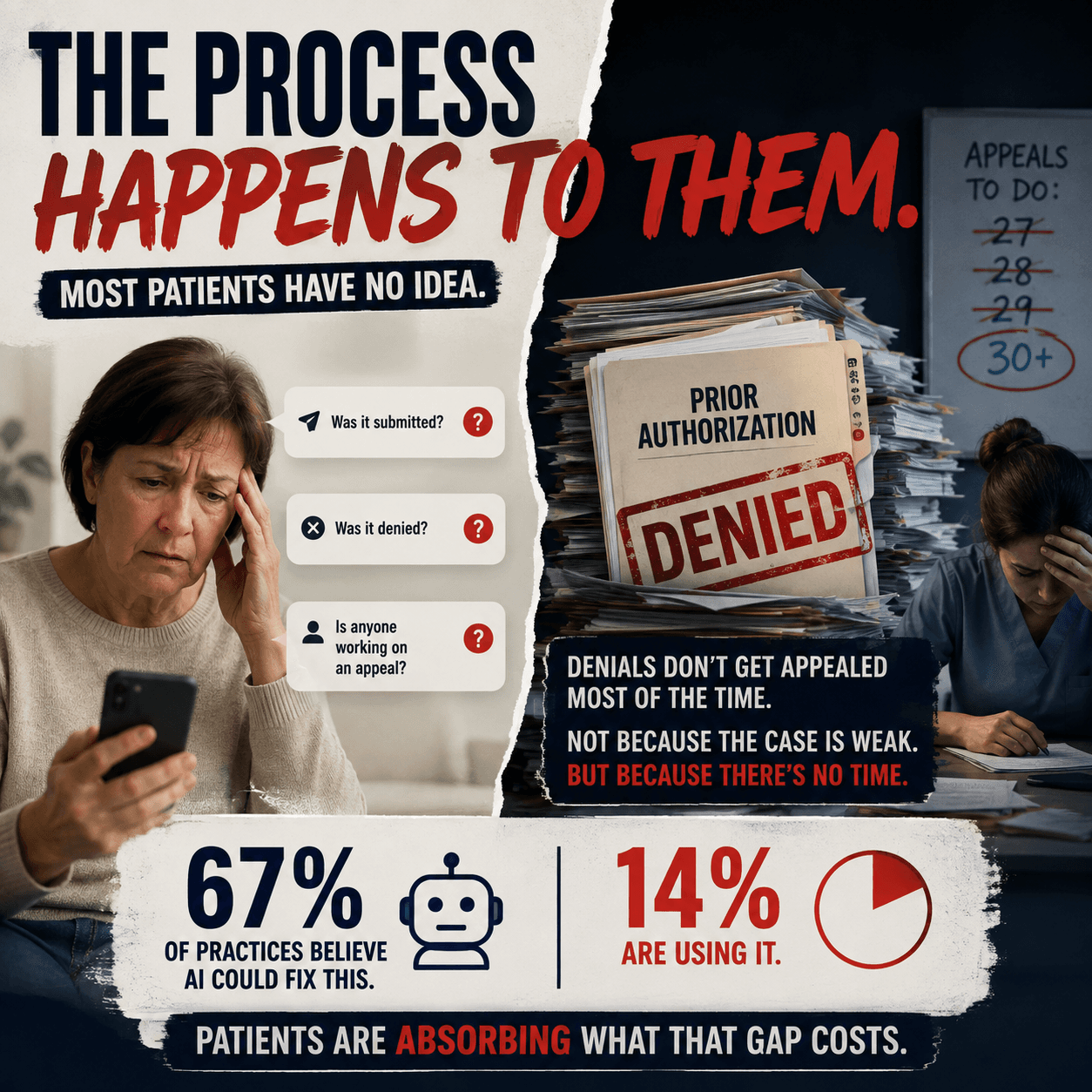
Physicians spend roughly 13 hours a week on prior authorization, according to AMA survey data. That's more than a full workday, every week, spent on something that isn't patient care and mostly isn't clinical decision-making either.
But the number that actually made me start building wasn't the time lost. It was this: when denials get appealed, roughly 80% are overturned. The clinical case was usually right all along.
And almost nobody appeals. Fewer than 11% of denied claims ever get a second look.
Sit with that gap for a second. It's not a story about payers being wrong and doctors being right in some abstract sense. It's a story about a system that quietly depends on practices being too underwater to fight back — and most of them are, because fighting back costs staff time nobody has spare.
That gap, not any particular villain in the story, is why Asaanbil exists.
What I actually built — and what I deliberately didn't
Asaanbil drafts prior authorization letters in minutes instead of the 25-45 it typically takes from scratch, citing the exact payer criteria a reviewer is checking for. It does the same for appeals, starting directly from a denial notice. No EHR integration required — I built it so a solo or small-group practice could start using it without turning it into a technical project first.
Here's what I deliberately didn't build: something that replaces a physician's clinical judgment. Every letter is a draft until a human reviews, edits, and approves it. I'd rather tell a practice honestly when a payer has no published criteria for a specific case than have the tool pretend it found a citation that isn't really there. That's not a marketing line — it's the actual standard the underlying system prompt is held to, because getting this wrong isn't a small mistake to make.
I also didn't build this to argue with payers' clinical standards. Asaanbil doesn't take a position on whether a payer's medical necessity criteria are reasonable. It just makes sure a practice's own correct clinical judgment actually gets documented well enough, and often enough, to hold up when it's challenged.
Why I'm starting narrow, on purpose
Asaanbil isn't trying to serve every kind of practice yet. It's built specifically for solo-to-small-group specialty practices — ortho, pain management, cardiology, and similar procedure- and imaging-heavy specialties — where a doctor or office manager is the buyer and a small non-clinical staff handles submissions.
That's a deliberate choice, not a limitation I haven't gotten around to fixing. A tool trying to fit every specialty and every practice size usually ends up fitting none of them particularly well. I'd rather build something narrow that actually matches how a specific kind of practice works than something broad that's mediocre everywhere.
What this means if you're running one of these practices
I'm not going to pretend a single piece of software fixes an entire broken reimbursement system — the reimbursement gap, the administrative burden, the reasons independent practices are under real pressure right now are bigger than any one tool. But the specific bottleneck inside prior authorization — the letter, not the underlying clinical judgment — is genuinely fixable, and that's the piece I built Asaanbil to close.
If you want to see whether it actually fits how your practice works, we run a free 10-letter pilot, no card required — and a direct line to me if you want to talk it through first. asaanbil.com (https://asaanbil.com)
Comments (1)
Sign in to like or comment.

nice