Your State May Already Require a Human to Review Your Prior Auth Denial
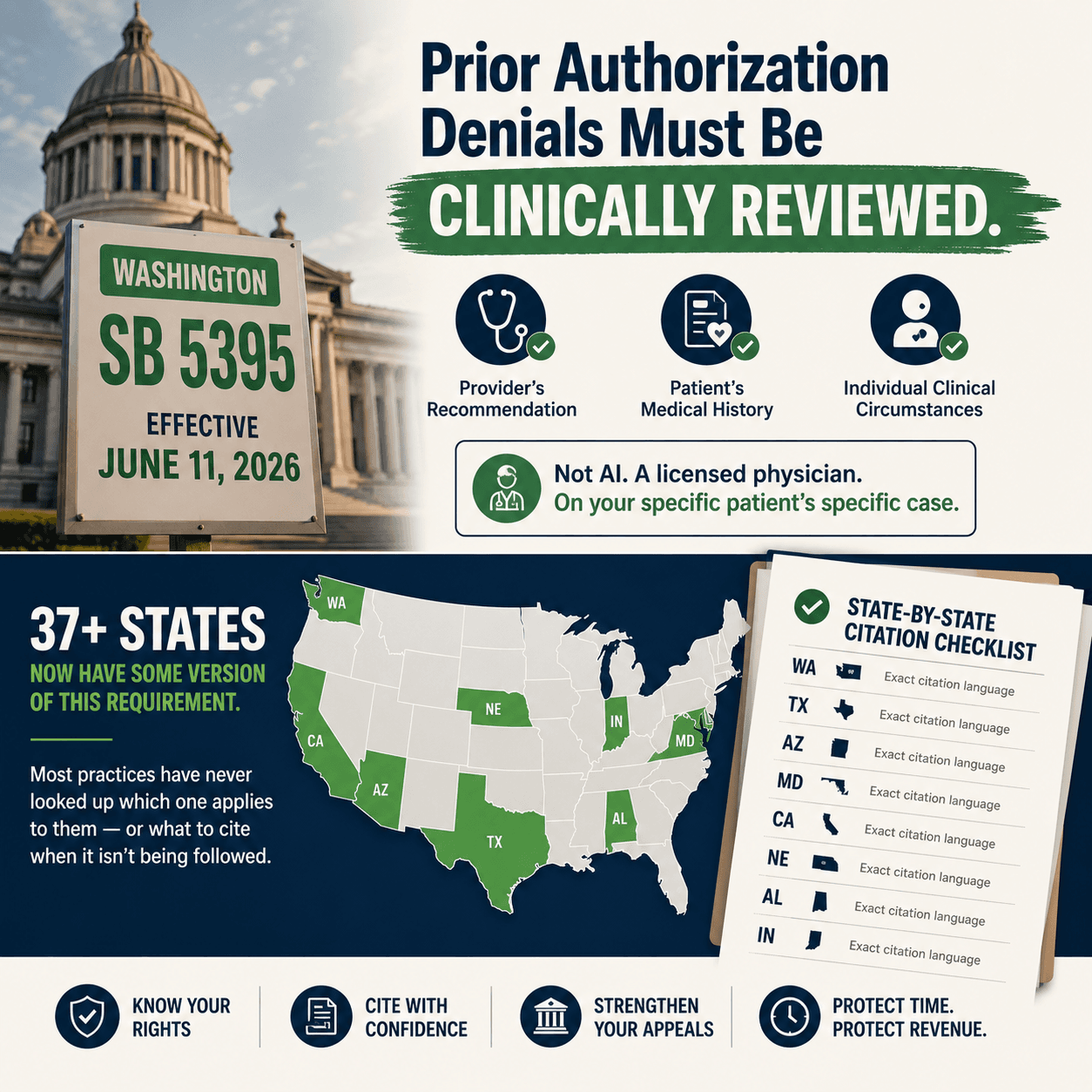
Washington's SB 5395 took effect June 11, 2026. It says this plainly: a determination of medical necessity shall be made only by a licensed physician or a licensed health professional working within their scope of practice. Algorithms may be used to process and approve prior authorization requests — but they may not be used without human review to deny care based on a determination of medical necessity.
Not AI. A licensed physician. On your specific patient's specific case.
Most practices in Washington — and in 37+ other states with comparable requirements — have never looked up what that law actually says, or what it specifically requires the reviewer to document. That's a tool sitting unused in every prior authorization denial that comes back from an insurer.
What Washington's law actually requires — and why the details matter
Washington SB 5395 goes further than a generic "human must be involved" standard. When issuing a notification for a prior authorization determination, carriers must provide the credentials, board certifications, and areas of specialty of the provider who had clinical oversight over the determination in any notification sent to the health plan enrollee and provider requesting the authorization.
That's a documentation requirement, not just a process requirement. The insurer has to tell you who reviewed the case, what their credentials are, and what specialty they practice. If that information is missing from a denial letter, that's a specific, citable gap.
Upon its effective date of June 11, 2026, carriers are required to immediately cease any practice where AI is the sole determinant for denying, delaying, or modifying prior authorization requests. The word "delaying" matters here — it's not just outright denials. A modification or a delay driven purely by an algorithm is also covered.
Washington also added a reporting layer: carriers must indicate the percentage of total denials that were aided by artificial intelligence tools and algorithms in their quarterly reports to the state Health Care Authority. That's public data, per plan, per quarter — a paper trail that didn't exist before.
The state-by-state picture
Washington is the most specific currently in effect, but it's not alone. Here's what's confirmed across the states with enacted requirements as of mid-2026:
Texas — prohibits utilization review agents from using an automated decision system to issue an adverse determination without human oversight. A licensed clinician must be involved in any medical necessity denial.
Cite in an appeal: Texas Insurance Code, utilization review human oversight requirement
Arizona — prohibits AI from being the sole basis for a medical necessity denial. A licensed physician or healthcare professional must make the final call.
Cite in an appeal: Arizona AI prior authorization human review requirement
Maryland — same core prohibition, plus a separate requirement for quarterly public reporting on AI use in adverse decisions — giving practices a paper trail to check for their top payers.
Cite in an appeal: Maryland AI prior authorization law + quarterly AI use reporting requirement
California — licensed physician or healthcare professional must make the final medical necessity determination. Bills addressing AI-driven claim downcoding without physician oversight are also moving in 2026.
Cite in an appeal: California utilization review clinician requirement
Nebraska, Alabama, Indiana — all three have enacted comparable laws requiring a licensed physician or healthcare professional to make the final medical necessity call.
Cite in an appeal: [state] prior authorization licensed clinician review requirement
Utah (effective January 1, 2027) — not yet in effect, but worth knowing: Utah will require insurers to publicly disclose whether AI was involved in reviewing a given prior authorization request. A new question to ask on appeal starting next year.
How to actually use this in an appeal right now
Ask directly, in writing, whether a licensed clinician reviewed this specific case — not just whether "the request was reviewed" in some general sense. In Washington specifically, ask for the reviewer's credentials, board certifications, and specialty, since the law requires this to be disclosed.
Cite the law by name and number in the appeal itself. A specific statutory citation — "Washington SB 5395, Chapter 157, 2026 Laws, effective June 11, 2026" — carries more weight than a general statement that AI shouldn't be making decisions. It names exactly what the insurer was required to do and asks them to confirm it was done.
If a denial came back unusually fast for a complex case, that's a reasonable basis to ask the question. Speed alone doesn't prove a human wasn't involved — but it's a documented trigger to ask for the reviewer credentials Washington now requires on every denial notification.
If your state isn't listed above, still ask in writing whether a licensed clinician reviewed the individual case. Federal CMS rules require specific denial reasons and turnaround times regardless of state law, and a payer claiming human review should be able to confirm it in writing.
What's not listed here
This covers enacted laws with confirmed effective dates. There are additional states with bills in progress that didn't make this list because they haven't passed yet — the number moving through legislatures in 2026 is growing, not shrinking. Search "[your state] prior authorization AI human review law" or check your state insurance commissioner's website for current status before assuming nothing applies to you.
The honest bottom line
Most independent practices are leaving this argument on the table entirely — not because the case isn't there, but because nobody told them to look. A specific, citable legal requirement that a licensed human reviewed your specific patient's specific case is a materially different opening to an appeal than "we believe this denial was wrong." Both may be true. Only one of them is checkable in writing.
Keeping track of the applicable standard state by state, and drafting the appeal letter itself, is exactly what asaanbil.com's appeals module is built to speed up — structured, criteria-cited, with a physician reviewing and approving before anything goes out. asaanbil.com (https://asaanbil.com)
Comments (0)
Sign in to like or comment.
No comments yet.