The Reimbursement System Is Rewarding a Building, Not the Work
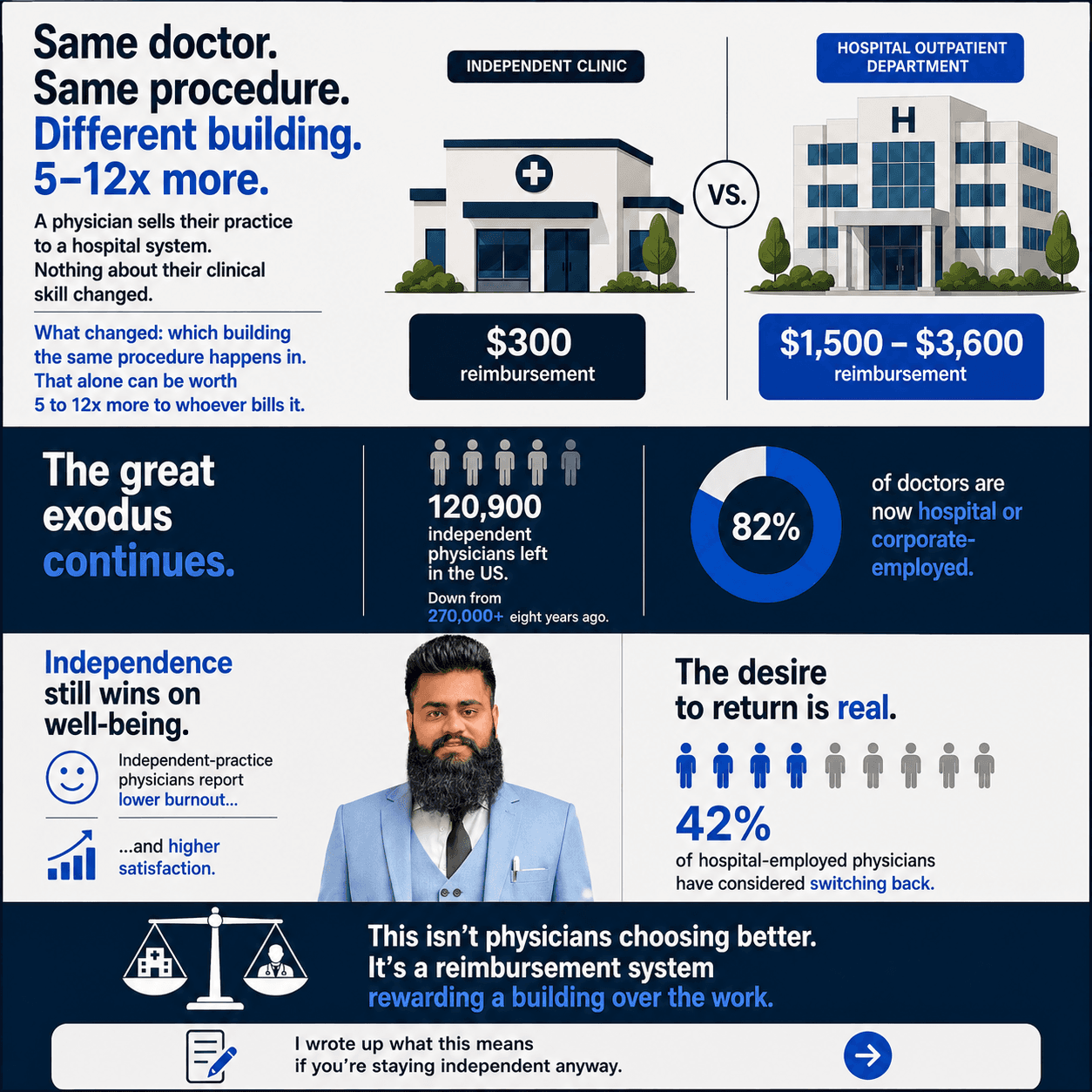
A physician sells their practice to a hospital system. Nothing about their clinical skill changed. Their patients are the same patients. The procedures are the same procedures. The only thing that changed is which building the work happens in.
That building is worth 5 to 12 times more to whoever bills for it.
The scoreboard
120,900 physicians in the US still run their own independent practice, per Avalere Health data for the Physicians Advocacy Institute. Eight years ago the number was over 270,000. 82% of practicing doctors are now employed by a hospital or corporate entity — a new high, and the pace hasn't slowed.
Rural areas are further along this curve: 80.2% of rural physicians are now employed, and roughly two-thirds of rural practices are no longer physician-owned.
The detail that breaks the "modernization" narrative
Here's the part that doesn't fit a tidy story about consolidation being natural progress: independent-practice physicians report lower burnout and higher job satisfaction than their hospital-employed counterparts. In a recent survey, 42% of hospital-employed physicians said they'd considered switching back to private practice.
That's not a small signal. That's nearly half of employed physicians saying the grass looked greener on the side they came from.
So this isn't physicians choosing better. It's a reimbursement system that rewards identical work done inside a hospital's four walls dramatically more than the same work done in an independent office — and physicians, on the whole, going where the money is despite preferring where they started.
Why the site-of-service gap is the actual engine here
Medicare and most commercial payers reimburse the same procedure differently based on where it's billed, not what's done. A hospital outpatient department billing for a knee injection, an MRI read, or a follow-up consult can collect anywhere from 5 to 12 times more than an independent physician billing for the exact same service. That gap is the mechanism. It lets a hospital system offer a physician a meaningfully higher salary for identical clinical work, funded entirely by a reimbursement difference that has nothing to do with outcomes or quality.
There's active federal attention on closing this — site-neutral payment reform has been proposed multiple times in Congress — but nothing has passed yet that meaningfully narrows it. Until it does, the financial gravity pulling practices toward consolidation isn't going away on its own.
What this means if your practice isn't going anywhere
Three things worth holding clearly, if you're staying independent on purpose:
Every hour of administrative overhead costs your practice more, relatively, than it costs a hospital system absorbing the identical burden across a much larger base with a dedicated team. The same prior auth denial, the same scheduling gap, the same missed appeal — each one lands harder on a two-person admin staff than it does on a system with a whole department for it.
Recruiting shifts from a compensation argument to a quality-of-work-life argument. The data backs this up — lower burnout, higher satisfaction, nearly half of employed physicians who'd consider switching back. Most independent practices aren't using this argument as explicitly as they could be.
Every dollar not lost to preventable denials, missed appeals, or admin inefficiency matters more at independent scale. There's no reimbursement cushion from being part of a larger system to quietly absorb the loss. The margin is thinner, and the tools that protect it matter more.
The part worth naming out loud
The economics are genuinely stacked against independence right now, and this post doesn't change a federal reimbursement structure. But the physicians choosing to stay independent aren't choosing worse working conditions — the data says clearly they're choosing better ones. The fight that's actually winnable at the practice level is keeping the admin overhead from doing to your margins what the reimbursement gap is already doing structurally.
That's exactly what asaanbil.com is built for — an AI front-desk platform that handles the scheduling, prior auth, appeals, staff coordination, and patient communication a small practice needs to run without building a big admin team to do it. One platform, built for the practice size everyone else skips. asaanbil.com (https://asaanbil.com)
Comments (0)
Sign in to like or comment.
No comments yet.