The Real Choice Independent Practices Are Being Given (And Why It's Not a Law of Nature)

"I can keep faxing things and hope, or I can spend more on software than I pay a part-time employee."
That's roughly how one practice manager described her options to me — and it wasn't an exaggeration. It's a fair summary of the actual choice most independent practices are handed right now when they go looking for help with prior authorization.
The two extremes on the market
On one end: free or near-free tools like CoverMyMeds. Genuinely useful — but built around pharmacy and medication PA specifically. If most of what a practice submits is imaging, surgical, or specialty-drug requests, it doesn't touch what actually eats the week.
On the other end: platforms like Cohere Health, Availity, and Optum's Digital Auth Complete. Real, capable systems, built for health systems with dedicated IT departments and procurement processes. Several don't even publish pricing publicly — it's quoted per-organization, which is usually a signal the pricing was never built with a solo or small-group practice in mind.
In between those two extremes, there's almost nothing.
The cost that isn't about money
The dollar figure is real — enterprise contracts running into the thousands per month, for a feature set a small practice will never fully use. But I think there's a quieter cost that matters more.
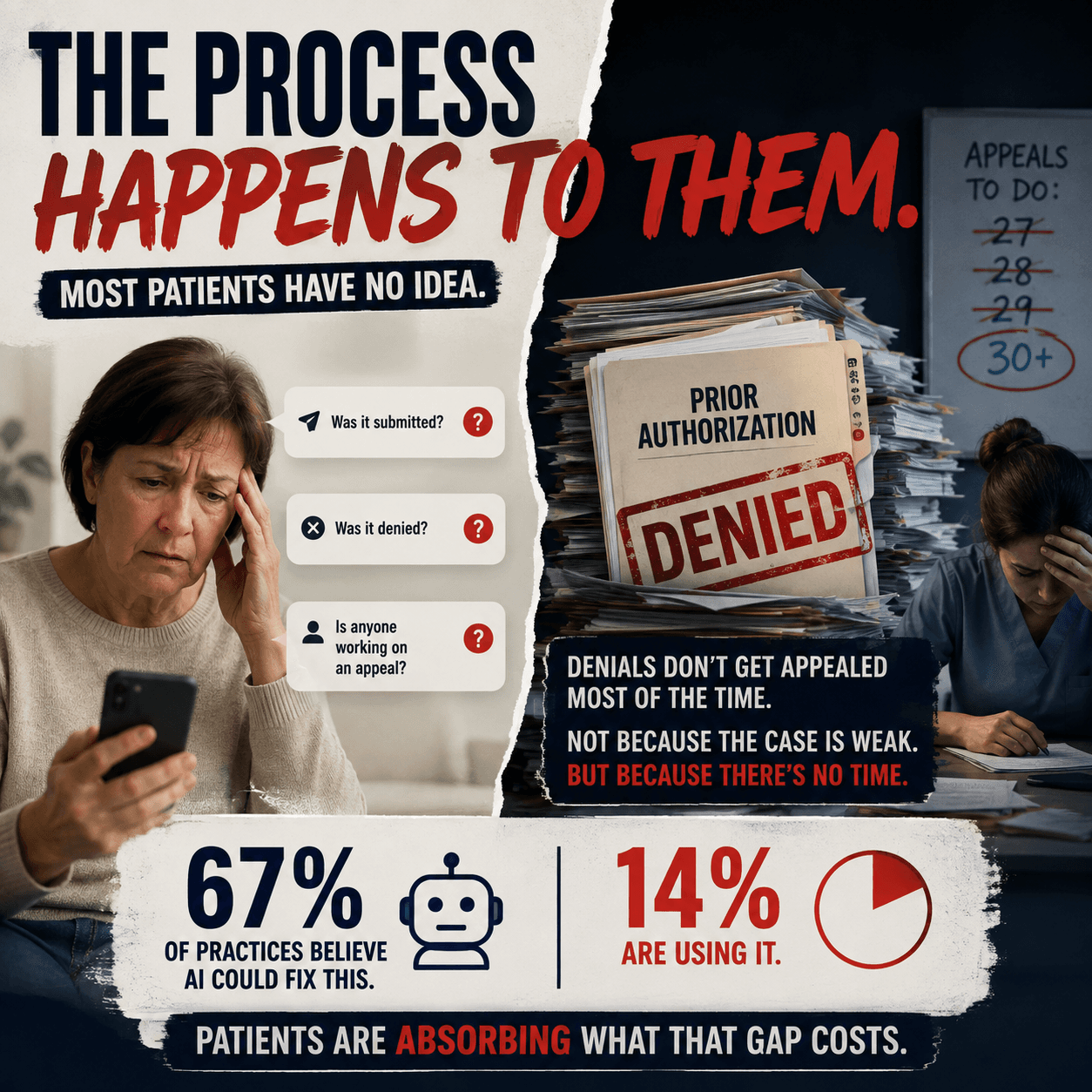
Practices start to assume that the absence of an obviously-right tool means this is simply what running a practice costs. The fax machine, the hold music, the guessing at which clause a payer wants this month — treated as the price of admission rather than a solvable problem.
I don't think that's true. I think it's a market gap being mistaken for a law of nature.
Why the gap exists, and why it isn't closing on its own
Enterprise PA vendors build for the buyer with the biggest budget — hospital systems, large multi-specialty groups with a procurement department. Free tools build for the highest-volume, most standardized transaction — pharmacy PA, where the workflow is simpler and more repeatable.
Neither business model has a natural reason to build specifically for a solo orthopedic or rheumatology practice submitting a mix of imaging, surgical, and specialty-drug requests every week. That's not a market failure exactly — it's a segment nobody's chasing hard enough yet, which also means it's the segment where a practice has the most leverage to ask hard questions before signing anything.
What to actually check before buying anything in this category
Ask what the tool was originally built for. A platform retrofitted down from enterprise use tends to keep enterprise-shaped assumptions baked in — EHR integration requirements, per-seat pricing, a feature set designed for a workflow the practice doesn't actually run. That mismatch rarely shows up in a demo. It shows up three months in, when a setup step that seemed minor turns into an implementation project nobody signed up for.
Check whether pricing scales with real volume, not a flat enterprise-style rate. A tool priced for hundreds of monthly PAs doesn't make financial sense for a practice submitting a few dozen.
Confirm the tool actually covers the payer and procedure mix in question. A platform built around pharmacy PA won't help with imaging or surgical criteria — the citation logic needs to match what's actually being submitted.
Ask directly whether EHR integration is required to function at all. If the honest answer is yes, factor in the real implementation timeline that requires, not just the sticker price.
The honest bottom line
The underserved middle here isn't permanent — it's just a segment nobody's built specifically for yet. Independent practices don't need enterprise-scale software sized for a hospital system, and a medication-only free tool doesn't cover the rest of what they submit. What they need is something sized for their actual procedure mix, their actual payer mix, and their actual volume — priced accordingly.
That's the specific space asaanbil.com is built to occupy: no EHR integration required, pricing built for a single-location practice, and letter drafting matched to the specific procedures and payers a specialty practice actually handles. asaanbil.com (https://asaanbil.com)
Comments (0)
Sign in to like or comment.
No comments yet.