The AI Adoption Gap in Claim Denials — And Why It's Not About Trust

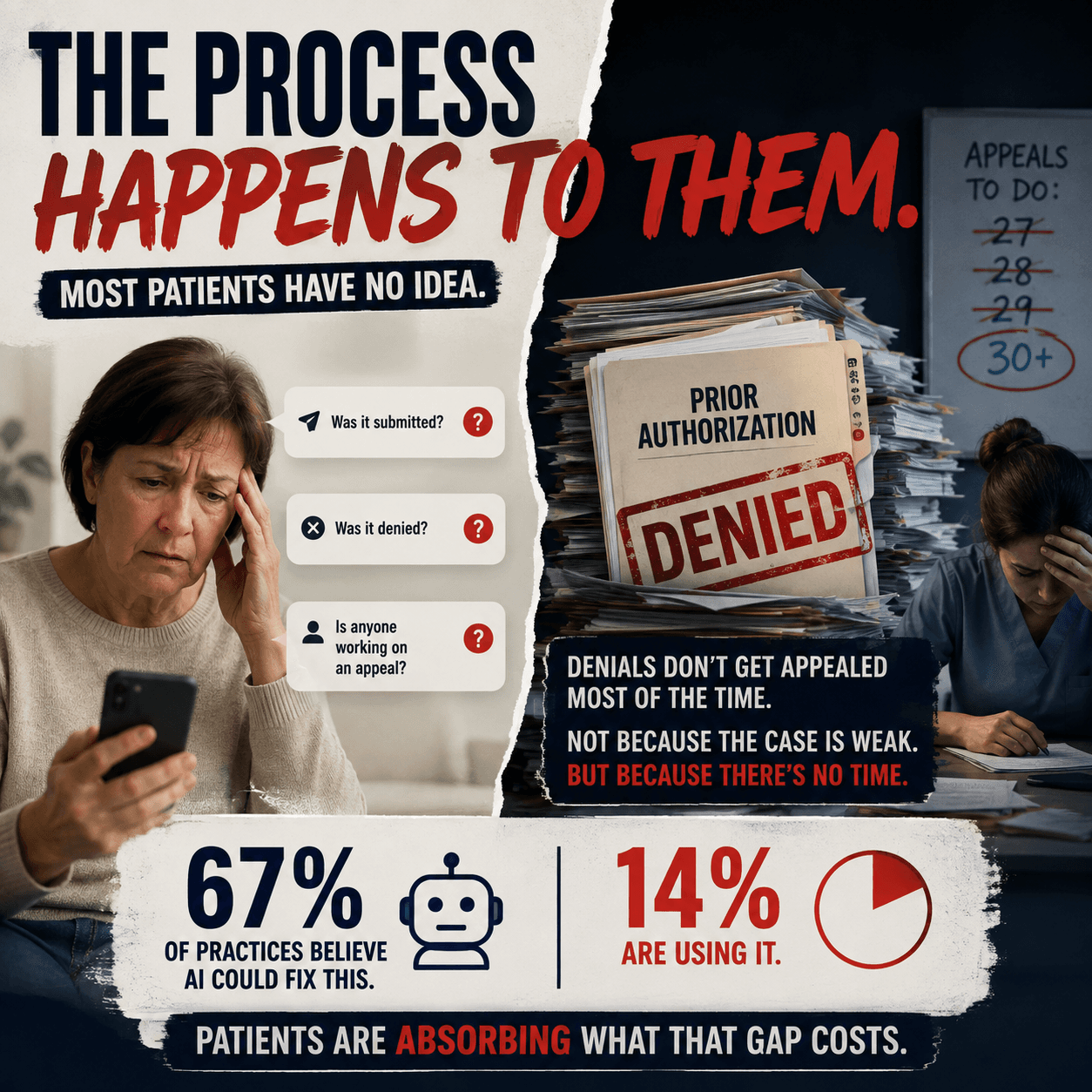
Ask providers if AI could help with claim denials, and most say yes. 67% believe it could genuinely help.
Ask how many are actually using it: 14%.
That's not a story about skepticism. It's a story about access.
The numbers behind the gap
Experian Health's State of Claims survey — an annual poll of finance, billing, and claims management professionals, tracked since 2022 — puts real numbers on a trend every practice manager already feels. 41% of providers now report denial rates of 10% or higher, a share that has climbed every year the survey has run.
It's not just denials getting worse. 54% of providers say claim errors are increasing, and 68% say submitting a genuinely "clean" claim — no missing fields, no formatting issues — is harder than it was a year ago. That's a different problem than clinical documentation getting weaker. It's the submission process itself getting more complex: more payer-specific requirements, more fields that have to be exactly right, more ways for a claim to bounce back before anyone even reviews the medical necessity of it.
Why belief isn't turning into adoption
Here's the number worth sitting with longest: 67% of providers believe AI could help with denials. Only 14% are using it.
That gap rarely comes down to doubting the technology. It comes down to three practical blockers, in roughly this order of frequency:
- The tool was priced for a much larger organization. Several leading platforms in this space don't publish pricing at all — it's quoted per-organization based on volume and integration scope, which usually means it's built around hospital-system economics, not a solo practice's.
- It required an EHR integration project nobody had staff to run. Vendor implementation timelines for full revenue-cycle suites can stretch to three to six months — a nonstarter for a practice where the same one or two people handle intake, billing, and denials.
- Nobody had the bandwidth to evaluate options while also handling this week's actual denials. Ironically, the busier a practice is with denials, the less time it has to fix the underlying problem.
None of these are trust problems. They're capacity and access problems — which means they're solvable without waiting for AI skepticism to fade, because the skepticism was never really the blocker.
Why this compounds harder for independent practices
A hospital system with a denial rate climbing past 10% can absorb it with a dedicated claims team and a six-figure RCM contract. A solo or small-group practice can't. The same one or two staff members handling intake, scheduling, and patient calls are also the ones reworking denied claims — usually squeezed in after hours, between patients, or on top of an already full week.
That's the compounding problem hiding inside these numbers: the practices facing the steepest relative cost from rising denials are the same ones with the least spare capacity to absorb the extra work, and often the same ones priced out of the very tools built to help — not because those tools don't work, but because they were built and priced for organizations that need them least urgently.
What to actually do about it
- Track your own denial rate, not just the industry average. If you don't know whether you're above or below 10%, that's the first thing to establish before deciding what to fix.
- Separate "error" denials from "medical necessity" denials. With 54% of providers reporting rising claim errors, a meaningful share of denials may be fixable with a documentation or submission change — not a clinical argument at all.
- Don't let "AI could help" stay theoretical. If you're in the 67% who believe it could help but haven't tried it, the real blocker is almost always cost-for-your-size or integration complexity — both solvable without an enterprise contract.
- Re-check claims denied for clean-claim issues before writing them off. A denial for a missing field or formatting error is often the easiest kind to fix and resubmit — don't let it get lumped in with denials you've decided aren't worth fighting.
The part that's actually solvable
The industry has already made up its mind that AI can help here — 67% agree on that much. What's missing isn't conviction, it's a tool actually built and priced for a practice this size, without requiring an EHR integration project or a contract sized for a hospital system.
That's the specific gap asaanbil.com's claims and appeals module is built to close: AI-assisted appeal drafting sized for a single-location practice, no EHR integration required, criteria-cited the same way a prior authorization letter would be. asaanbil.com (https://asaanbil.com)
The belief that AI can fix this is already there, across the industry. The next twelve months will separate practices that turn that belief into something they can actually use from the ones still waiting for a tool that fits.
Comments (0)
Sign in to like or comment.
No comments yet.